Top 10 Tuesday: Bookish Pet Peeves
This week’s Top 10 Tuesday (hosted by the lovely ladies at The Broke and The Bookish) question concerns bookish pet peeves. At first, this baffled me–I was all like, “I love books, nothing about them ever bothers me.” And then I realized that that is a humonstrous lie. The more I thought about it, the more pet peeves I realized I had. It’s quite the list actually. So I’ve broken it up by category. And I’ve added some pictures to illustrate. And I use CAPSLOCK and itals a whole helluva lot. Because apparently I feel very, very strongly about the bookish pet peeves I didn’t realize I had until a couple days ago…haha.
Alright, ladies and gents, heeeeeeere we go!
Story Elements
2. “Creative” Names
I have no problem with “creative” names if there is a reason for the name to be creative–the mom is crazy, the dad is obsessed with Greek mythology, the character is named after some ancient relative with a ridiculous name, etc. But when a character is named Calypso or Indigo or Bunny for absolutely no reason, I just can’t deal with it. I don’t know why.
Covers

3. The Twilight-endorsed/ Twilight-centric covers
I know it’s a marketing ploy, but it PISSES ME OFF. I think it literally makes my blood boil. I was actually in a bookstore not long ago, and a woman asked me if she should buy her teenaged niece Wuthering Heights or Pride and Prejudice, and she pointed at the books with the now-famous black, white, and red covers and the stupid “Edward & Bella’s favorite book” graphic. I said “You should get her both books, and throw in Jane Eyre for good measure,” and followed up my suggestion by begging her to buy an edition with a different cover. She did. I’m that good.
4. Endorsements
You know those blurbs that are sometimes on books that say “This is a world I’d love to live in!” or “A wonderful debut from a dazzling new talent!” and is credited to some famous author/reviewer? I hate those blurbs. Loathe them. I want to smash them with a hammer. I also hate them on movie posters. (Apparently I just hate endorsements.) At least my hate is steadfast.
In the Bookstore
5. Judgmental Booksellers
Yo, I’m buying books. I’m supporting publishing and your bookstore. DON’T YOU DARE pass judgment. (Unless you’re the Judgmental Bookseller Ostrich. Then it’s fine.)
6. Disorganization
I super like indie bookstores. And I actually like bookstores with a decent amount of clutter, you know the ones that reek of “crazy book/cat lady who only drinks tea”?–those are fun. But the ones where nothing is labeled and there are just stacks and stacks of random dusty books in random dusty piles and not even the proprietor of the establishment knows where anything is, make me CRAZY.

7. The Shelf-Blocker
You know that person who grabs seven books from a shelf and then STANDS there and flips through all of them, all the while blocking the shelf so that no one can get to it and acts like they can’t see you/hear you coughing awkwardly? I DESPISE this person. I wish a pox upon their house when I see them.
At the Library

8. Writing in books
If I own a book, I will mark that bitch up. I’ll highlight, underline, write in the margins, and flag pages. If I buy books as a gift, I write my own personal dedication on the title page. So, I am not AT ALL opposed to writing in books. But I AM opposed to writing in library books. Maybe this is hypocritical, but it’s still true. The last thing I want when I check a book out from the library is someone’s doodles or thoughts written in. (Unless, you know, they’re good. Haha!) To be honest, there have been a couple times when I’ve decided to share my enthusiasm for a quote or passage or whatever with another Queens Library patron, but I write it on a sticky note and put it inside the book before I turn it in.
9. The Careless Alphabetizer
There are few things worse than asking a librarian/consulting the online catalog, being told by human/computer that the book is available to be checked out, happily bouncing over the shelf to get the coveted book, and then . . . Where THE F@$K is it?! And you look at the shelf above. The shelf below. You look three times. You walk farther down the aisle, knowing that it won’t do any good. Then you go find a library worker, who is normally a volunteer, to ask if they know where it might be. And then they do what you just did. And, if they’re nice, they go look in the “back room” for it. They normally don’t find it. That leaves you, annoyed, and bookishly unsatisfied. Grr Argh.
10. Due Dates
Normally due dates don’t bother me, but I’m currently suffering from the my-TBR-is-growing-and-my-library-books-are-due-but-I-haven’t-read-them-yet fever. Due dates are no longer my friend.
So that’s my listy-list! Feel free to share your bookish pet peeves in comments or on the Twitters!

Why I Hate Historical Time-Travel Books
First of all, I want to make it very clear that I don’t hate books about time travel. I hate books about historical time travel. The difference is that in historical time travel, the main character, typically from present day travels back in time through some sort of portal or dream or magic to a time period that he or she is studying/way into/has some sort of importance for them. (Sometimes it’s a historical character who comes to modern times, but that is more rare.)

This sounds like a great idea, right? I mean, who hasn’t daydreamed about seeing Classical Rome in its heyday or looking at Impressionist paintings in a French salon or going to a Bob Dylan concert in the ’60s? It would be an amazing experience, one that we would never forget. But the difference here is that we know what happens after that day–we know how its all going to go down. And that knowledge, though great, is kryptonite for the historical time traveler (HTT).
You see, typically, the HTT and all of his (or her) modern sensibilities ends up wreaking havoc on the lives of the people in whatever century it is that he (or she) travels to, makes a complete and total ass out of himself (or herself), and then at the end realizes that he (or she) misses his (or her) life back in his (or her) own time period, but he’s (or she’s) learned something that he’ll (or she’ll) never forget. Huzzah.
Now, if that was all that happened, it wouldn’t be so bad. But normally there are a couple narrative devices thrown in for funsies that just really aren’t okay. Most notably, the love story in which a person from modern times falls in love with person from olden times and then there’s a crisis–does modern person stay in olden time, or does olden person come to modern time, or do they just call it a day? No matter which solution the author chooses, it’s never quite a “happy” ending–one of the characters has to give up quite literally everything they have ever known to be with the other person. Another problem that can arise in this sort of story is the “I ended up marrying my great great grandfather, which means that I’m my own great great grandmother” as exhibited in the classic American film Kate & Leopold. It’s just creepy.

Another weird narrative device is the one where the HTT ends up helping invent something/solving a problem/finding the answers to something that he/she has been pondering or working on. This is especially true in mystery novels where the HTT is trying to solve a mystery, hits a dead end, travels back in time, and just so happens to run smack into the VERY PERSON that they need to run into to solve the mystery. This is just ridiculous. And if it ends up that the HTT used their modern knowledge to help invent some sort of great thing, it’s kind of rude to history–it’s basically saying “Hey, you, historical person. You weren’t smart enough to figure this out. No, siree. A time traveler obviously helped you do this.”
This actually happens in Revolution [Prepare for SPOILERS]–Andi meets the oh-so influential composer she’s writing her thesis on, and he listens to her iPod and is really into the very musicians whose music he informed through the music that he has yet to write when he meets Andi, which basically means that she introduced him to the musicians that were inspired by him, but now he is inspired by both them and by music he has yet to write. Which means!, Andi is the person who is responsible for the piece of music that she considers to be so fantastic because she’s the one who introduced him to the musicians who were inspired by the music he has yet to write. It’s nonsensical! Okay, it’s a little romantic. But mostly, it’s nonsensical.
I’m sure that there are those of you out there who are thinking “All of this sounds cool. You’re just no fun.” And maybe that’s the case. But I think the main reason why I hate historical time travel books is because I always come away from them really, really unsatisfied. Maybe it’s because I know I won’t ever be able to do it. Maybe it’s because I feel weirdly protective of history and don’t want it tampered with. Whatever the case, I seriously dislike historical time travel.
If you need some convincing of my position, just watch the BBC mini-series Lost in Austen. You’ll understand afterward.
Review: Revolution
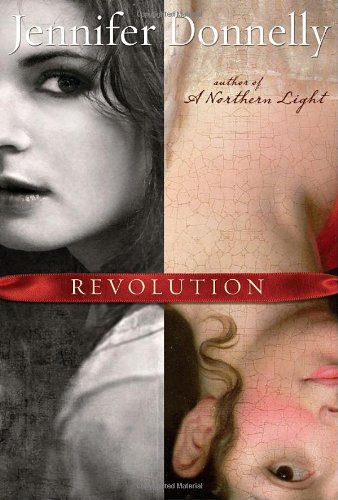
Title: Revolution
Author: Jennifer Donnelly
Publisher: Delacorte Books for Young Readers
Pages: 472
Pub Date: October 12, 2010
Format: Library book
BROOKLYN: Andi Alpers is on the edge. She’s angry at her father for leaving, angry at her mother for not being able to cope, and heartbroken by the loss of her younger brother, Truman. Rage and grief are destroying her. And she’s about to be expelled from Brooklyn Heights’ most prestigious private school when her father intervenes. Now Andi must accompany him to Paris for winter break.
PARIS: Alexandrine Paradis lived over two centuries ago. She dreamed of making her mark on the Paris stage, but a fateful encounter with a doomed prince of France cast her in a tragic role she didn’t want—and couldn’t escape.
Two girls, two centuries apart. One never knowing the other. But when Andi finds Alexandrine’s diary, she recognizes something in her words and is moved to the point of obsession. There’s comfort and distraction for Andi in the journal’s antique pages—until, on a midnight journey through the catacombs of Paris, Alexandrine’s words transcend paper and time, and the past becomes suddenly, terrifyingly present.–Goodreads
While reading Revolution, I was awestruck. Donnelly spins an intensely tragic, raw tale of two girls in two different times, but whose stories are the same. Both are hurt, angry, and desperate in a way that I hope to never know. Both want to act, want to make a mark, and want to go out with a bang. I couldn’t get enough of it. I was racing through this book, praying my lunch breaks at work wouldn’t end so that I didn’t have to stop reading. But, of course, they would end.
So last night, I canceled my plans so I could go home and finish this book. (I’m not joking about that.) I read and read and read, and then, about 100 pages from the end, something happened. All of a sudden, Donnelly was using my LEAST FAVORITE narrative technique–the historical time travel.
I know what you’re thinking–‘But, Bethany, did you not read the summary of the book? It plainly states that “the past becomes suddenly, terrifyingly present.”‘ Yeah, I got that, but I didn’t think it was going to be literal. I mean, Andi is crawling around in the mothereffing Parisian catacombs while reading a diary from the French Revolution. That’s pretty terrifyingly present if you ask me.
Anyway, after spending so much time and energy and emotion with Revolution, I found myself getting angry. The book had been so informed and smart and tonally solid and heart-wrenchingly beautiful that I didn’t think it could go wrong. But when I got to the part where Andi enters the catacombs and starts talking to the “hot goth guy,” I found that a conversation I’d had with a co-worker was coming true–she asked me how I was liking this book and I said, “I love it. I’m a little obsessed with it. But I’m afraid it’s going to go to a weird time-travely place, and I really, really don’t want it to go there.” And as I sat there, at 1:00 AM, devouring this book, I realized that that’s EXACTLY where it was going.
I was pissed.
I called my boyfriend and RAILED against it. I cussed the book in English, French, and maybe Pig Latin. He said, “Wow, you must really like this book to be so mad about this. Just calm down and finish it.” [Mr. Bethany is sort of great.]
So that’s what I did. And as I kept reading, I realized that while Donnelly did use the hated historical time travel technique, she also did something different with it, something that left it open to interpretation. So I’m going to interpret it as NOT historical time travel, and that makes me a much, much happier Bethie.
Overall, this book is fantastic. It’s beautifully crafted, extremely well-researched, and has a V for Vendetta vibe to it. So, if that’s your thing, or if you’re a historical fiction nerd and Francophile like me, then you will adore this book. But I’m warning you, this book is not for the faint of heart (or stomach)–Donnelly spares no disgusting detail when describing the conditions of the French Revolution and there are a couple places that were a little hard for me, the girl with a History major and French minor, to get through. But hopefully that won’t stop you from RUSHING to get this book. And if you do, clear your calendar. You won’t be able to put it down.
TGIF: Cover Lust
This is my first week doing TGIF, a meme hosted by Ginger over at GReads!, and the question she posed is this:
This is quite the question, non? No matter what people say about the publishing industry and the downward spiral of print books and blah blah blah, there is nothing quite as exciting as walking into a bookstore (or library or friend’s place or passing a stranger reading in a park) and spotting a cover that immediately grabs your attentions and forces you to walk toward it. I’m pretty sure I’ve felt that way toward more books than I have men. Just sayin’.
But, there are lots of pretty covers. Too many for a single blog post! So, for me, a cover that is memorable is one that requires thought, and, in a weird way, one that requires that I have an emotional connection with it. And I’m not talking an emotional connection with the words that are housed inside the cover–I’m talking the cover itself. It needs to resonate with me on its very own. [All of a sudden I feel like I’m taking this too seriously. Oh well, no looking back now!]
Anyway, enough of my rambling, let’s get started, shall we?
My first pick is a cover I’m sure is going to be a popular choice for this TGIF. It’s the iconic, haunting cover for The Great Gatsby created by Frances Cugat. It took me a looooong time to understand how perfectly complex, and perfectly ironic, this cover is. It’s genius. In fact, I like the cover more than I like the book!


Alright, them’s be my picks! Let me know what your favorite covers are, and allll about your weekend plans, in comments! TGIF!!
Review: Wings

Title: Wings
Author: Aprilynne Pike
Publisher: HarperTeen
Pages: 294
Pub Date: April 6, 2010
Format: Library book
Faeries have never been my thing. I honestly don’t know that much about them or their lore, and, if I’m being completely honest, I probably wouldn’t have ever picked this book up if it wasn’t for the Goodreads book group I’m in. This was their pick as a group read for March, sooooo I read it.
So, okay. The basic plot here is that the main character, Laurel, has moved to a new town when her parents decide to open a book store. Then she discovers that she is a faery–this happens when Laurel all of a sudden sprouts petals, that look like wings, from her back. It’s important to note that they are petals, because in this series, *SLIGHT SPOILER ALERT* faeries aren’t genetically people–they are plants who look and act and feel like humans. Anyway, Laurel befriends a very sweet and scientifically-minded boy named David who thinks that she’s the cat’s pajamas, and she doesn’t really know what she thinks about him, at least romantically speaking. All the while her parents are trying to sell their old house/land and are having difficulty getting a buyer. Then when they do get a buyer, Laurel has a weird, weird, super weird feeling about him, and turns out that–surprise!–the land she grew up on belongs to the faeries and she has to make sure it isn’t sold to someone who is not a faery. Get it? Goooood.
I found the first half of the book achingly slow. It was all about Laurel adjusting to life in her new high school (she had been home schooled), and it was literally “Laurel sucks at biology,” “Laurel has weird eating habits” [OMG major sidebar–Her eating habits are this: she eats raw fruits and veggies and drinks Sprite. No, the play on words is not lost on me here. Anyway, while reading all about her raw foods diet, I was scarfing down chocolate chip cookie dough ice cream and enjoying every second of it. I did not once feel guilty.], “Laurel is really pretty,” “Laurel is still getting used to this whole school thing,” “David is paying Laurel attention and she’s not sure why,” for about half the book.
That would be a-okay with me if the main character was interesting. Laurel is definitely different, but there’s just something so squeaky clean about her–there’s no edge, and once you realize that she’s a faery (which is never really a mystery) there’s nothing all that mysterious about her.
Things finally started to heat up when Laurel meets another faery, Tamani (boy!), who is the first character in the book that isn’t completely vanilla. Although I like David, and find him very sweet, he’s boring. I assume that in the trilogoy, that’s his role–he’s the sweet, safe choice while Tamani will be the edgy, more seemingly-exciting choice.
Anyway, the book kept going, and I kept reading, and then finally there was some much-needed action thrown in about 3/4 of the way through.
But my favorite part was when Tamani briefly (so briefly!) explained the history of faeries to Laurel. This included Avalon (!!!), King Arthur (!!!!), Merlin(!!!!!), and King Oberon (!!). Like I said earlier, faeries aren’t really my thing, so maybe this is typical in the faery-canon and is old hat for all you faery genre readers, but I TOTALLY DUG this part. I really wished that all of that had come earlier in the book. In fact, I wish the editors had cut out a lot of the adjusting to the new school, sucking at biology stuff, to insert more faery history stuff. But then again, I was a history major in undergrad, so maybe I’m biased. 😉
As the book started to wrap up, the last couple pages kind of force a love triangle–not that it wouldn’t have come by itself–I’m sure that it would have. While reading there is definitely a discernible romantic tension between David-Laurel and a more sexual tension between Tamani-Laurel, but I figured the love triangle would come to fruition in the second book. Instead, it was thrown in at the end of the first book, and to me, felt very very awkward.
Overall, Wings was a quick, light read, and since finishing it, I’ve found myself wondering about where Pike took the story in the next book. I’m not necessarily in a rush to read the next one, but I’ll definitely put it on my list of things to-read.
In the meantime–if you are a faery genre lover, I would love to have recommendations for some books! Leave ’em in comments s’il vous plait!




 Bethany Larson